
 By artistkb1993@gmail.com
 In this article, we will understand what a marketing funnel is, how it works, its benefits, and how to create it. Let’s see it.
What is a marketing funnel?
A marketing funnel is a path that describes the customer journey at different stages from the start to the end, i.e., when the customer hears your product name for the first time to making a final purchase.
This marketing funnel is used to monitor customer behavior at each stage and nurture them accordingly. The ultimate aim is to push them to the next level of the funnel and then to the final purchase.
Who can use a marketing funnel?
Anyone can use a marketing funnel, whether a small B2C business or a large B2B organization. A B2B marketing funnel is longer and generally contains a larger number of stages, whereas a B2C marketing funnel is shorter and includes fewer stages.
Why is a marketing funnel beneficial?
By using a marketing funnel, businesses can monitor their customers’ behavior at different stages. Once they understand customer needs, they can address their pain points and highlight benefits at different stages. This results in better engagement and a higher conversion rate.
Get clear idea of following
- Targeted audience
- Selection of social media channel
- Content planning and creation
- Budget allocation
- Data for future reference
What are marketing funnel stages?
The stages of the marketing funnel may differ according to business model and volume of business. However, there are four basic stages that form the foundation of any funnel. Every business will follow these stages.
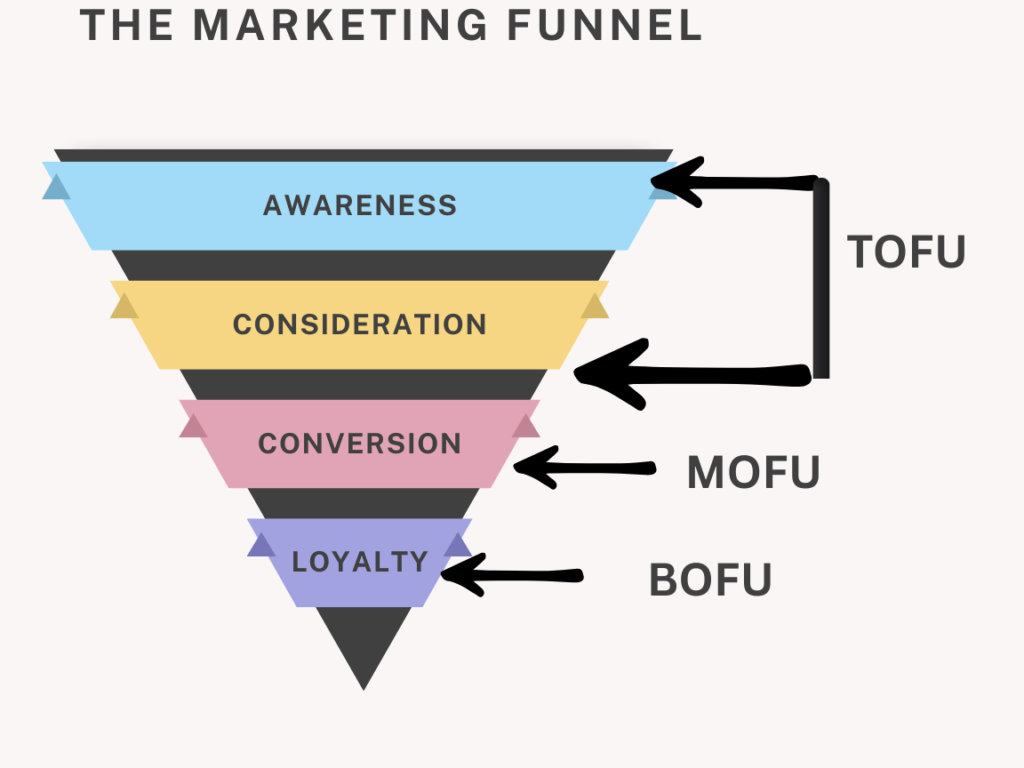
a. Awareness Stage:
In this stage, the customer may hear the product name for the first time. They are in the awareness or education stage and try to learn more about the product. The volume of customers is usually highest at this stage.
After this, they may seek more information by visiting the website or landing pages and social media accounts. Therefore, the proper CTA or redirection is vital at this stage.
b. Consideration Stage:
Once people become familiar with your brand name, first they evaluate whether they need your product or not. During this stage they may read articles, explore social media channels, watch YouTube channels, and visit website pages to gather more information about the product.
C. Conversion Stage:
At this stage, the customer is ready to make a purchase. They will check product reviews, read testimonials and FAQs, and check competitors’ websites for cost and quality comparison. Here, they can purchase the product or go out of the funnel.
d. Loyalty Stage:
After purchasing a product, it’s really important to nurture them with messages, email, customer support, and new offers. This is important for maintaining healthy relationships and encouraging repeat purchases.
During all these stages, collecting their mobile numbers, email, and product interest is vital for lead generation.
At every stage, whenever a customer visits your website, they should be encouraged to fill out one short form.
How to create a marketing funnel?
To create a marketing funnel, one should understand their business and audience thoroughly. According to that, they should create a funnel as follows.
1. Identify your audience
Get a clear idea of your targeted audience, their age group, income range, and pain & gain points. This will help you in better targeting and content creation.
2. Create content
Once you get a clear idea of your targeted audience, select platforms. Write a long-form article to educate them and create short social media posts and product walk-through & unboxing YouTube videos. Target your audience with ads. Write a proper CTA for redirection and lead generation.
3. Generate & nurture leads
Collect data from visitors and nurture them with messages and emails. Make different message templates, such as introduction of company, product intro, customer review, and offers/discounts.
4. Support Conversion
If they start engaging, reply to them, suggest more informational content, and try to build a healthy relationship.
5. Conduct funnel analysis
The last and most important step is to analyze your funnel from time to time. There are some stages where customers go out of the funnel; identify these leak points and try to fix them.
Example: Marketing Funnel for a Personalized Gift Shop
- Target customers: Young generation and adults.
- Run ads:- Valentine’s Day and Raksha Bandhan. (awareness)
- Long-form content: “10 Best Gifting Ideas for Your Loved Ones” (awareness)
- Social media posts, Instagram, Facebook, and YouTube videos. (consideration stage).
- Finally, use customer reviews and limited-time offers to drive purchase decisions and convert viewers into buyers (conversion stage).
A marketing funnel is a data-driven approach that demands continuous monitoring and modification. Each funnel comes up with data that shows leak points, customer preference, and friction in the user journey. Based on these insights, the next funnel should be refined and improved to enhance overall performance and conversion rate.
[…] In this article we will break down what the target audience is and why it is important to know it before starting working on any project. This term is not restricted to only content writers. It’s an essential part of the marketing funnel. […]