
 By artistkb1993@gmail.com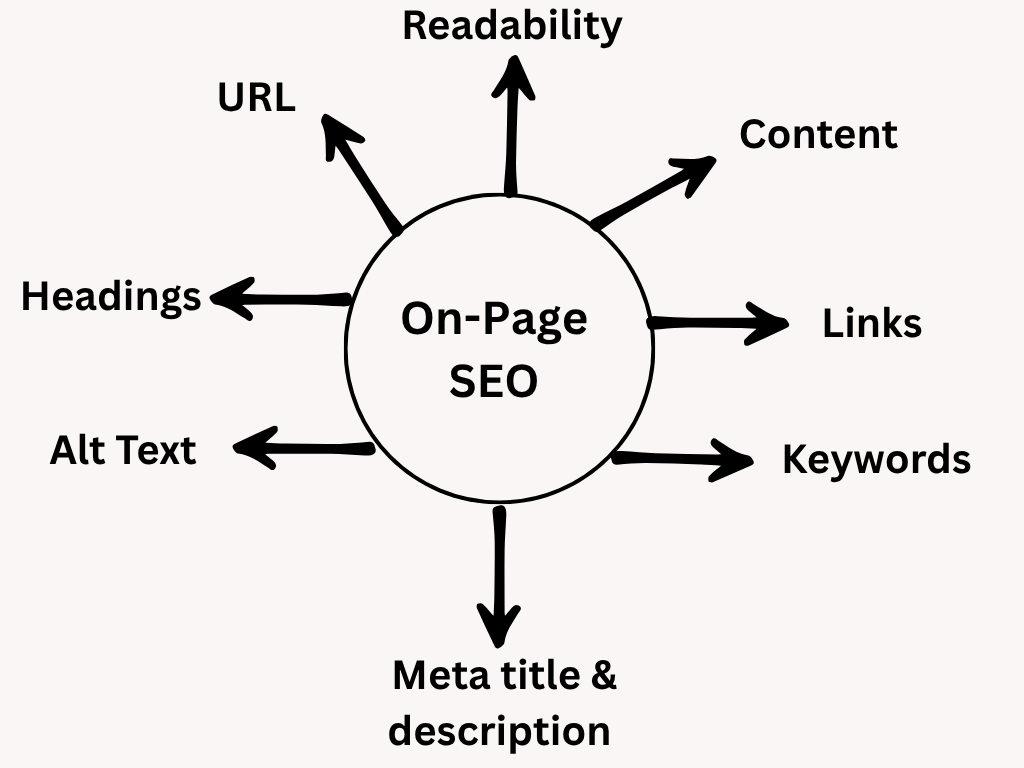
“Once you decide on the topic, start writing and complete your article. However, before publishing make sure to check a few things. “
What are these things? How to check it? How to correct it. All these things we will understand in this article. So, after reading this article, you will be ready with your on-page SEO checklist. Let’s begin.
What is mean by On-page SEO??
On-page SEO is one of the techniques of search engine optimization, which is performed within the website page to make it more aligned with search engine results pages and rank higher.
What is an on-page SEO checklist?
The on-page SEO checklist contain following points:-
1. Primary keywords:
The primary keyword, often known as a “seed keyword,” through which Google understands and ranks your content or product. At the same time, users use this as a search query to make a search in search engine results pages (SERPs).
“Eg., In this article my primary keyword is “On-Page SEO Checklist.”
Primary keywords should be present in the title, within the first 100 words, and one of the H2, and H3. Ideal density is 1 to 2% of the total word count.
Eg., a 700-word article = 7 or 14 times primary keyword (7 times is ideal)
2.Secondary keywords
A long-form query with seed keywords indirectly delivers the same meaning as primary keywords. A 3 to 6 word long query usually formats with what, why, and how words. Similar words, called “once included,” also come under this category.
Eg., “how to create on-page SEO checklist”
Best practices: While writing, highlight your primary and secondary keywords by making them bold or giving them another color. Make one table before writing as below.
| Primary keywords (1% of total word count) | Secondary keyword (2 to 3 times) (can slightly change according to content) | Once included keyword (only one time) |
| On-Page SEO checklist | how to create on-page SEO checklist on-page SEO techniques | what is on-page SEO checklist for content writer importance of on-page SEO checklist |
3.Heading Structure
Before heading towards writing, make one outline of your article that clearly shows the title, H1, H2, and H3.
| Heading | Use Case | Times |
| Title & H1 | With primary keyword | 1 |
| H2 | At least two H2 with primary keyword | 3-5 |
| H3 | Optimize with SERP query | Under each H2 there should be at least three H3 |
| H4-H6 | Not recommended for blog post | Long-form content multiple bullet points |
4.Readability
The content must be written in easy language with short sentences, correct grammar and punctuation. Ideal word count is 800-900 for an article, if the topic is vast then one can go beyond this.
To make content more engaging and readable add some table, visuals, and practical examples.
5.Internal & External linking
To make content credible add one internal & external link. Internal linking is given within the website, usually it gives more information or relevant information about the same topic. It helps crawlers to visit more pages of your website.
An external link is given outside of our website to one of the trusted sources like wikipedia. It simplifies one of the hardest topics related to the article. It helps to build credibility.
6.Meta title & description
These two terms are shown on the search engine result pages; it provides a short review of the page . A meta title is 50-60 characters long and delivers insides of the page.
While a meta description is 150-160 characters long, it includes primary keyword, feature, CTA, offer, and any other important information. An engaging and informative description results in a higher click through rate (CTR).
7.URL Structure & Permalink
A short and primary keyword optimize URL & permalink structure is ideal to deliver more information about the topic for crawler and audience.
8.Image Alt text
This term is useful for crawlers and blind people to understand the meaning of images. So images should be optimized with primary keywords and short descriptions.
A content written and optimized with the above SEO techniques will align better with both google algorithms and the user intent, resulting in higher engagement and improved search ranking.
[…] WordPress, Canva, Microsoft Excel, Microsoft Publisher, Google Analytics, SEO, and other skills. This will make you more industry-ready and help you to grow better—open new […]