By artistkb1993@gmail.com
Many of you may be familiar with the word “keywords” in SEO. What are these keywords? Why are they important in SEO? What are the types? How do you use them in your content? In today’s article, we will cover all these topics.
What are keywords in SEO?
Keywords are the most commonly used words or names used by sellers and users for products or services.
E.g., the Kholapuri chappal is a traditional Indian footwear style widely recognized for its cultural significance. Well known as “Kholapuri chappal” amongst sellers and buyers. By using these keywords, one can increase organic traffic for their business.
A seller will list it on the website as a royal Kholapuri chappal and a Kholapuri chappal for men and women. At the same time, the user will search for the best Kholapuri chappal near me. Now, the primary keyword in SEO is present at both ends. And Google will surface your site to the customer based on that keyword.
This is how it works. Google analyzes keywords in two formats. The first is the primary keyword, i.e., the seed keyword, and the long-tail keywords, which contain what-, how-, and when-type words, are considered secondary keywords. To rank content in search engine result pages (SERP), content should be naturally incorporated with both keywords.
Why is it important for SEO?
Google cares more about users and the user experience. This term is usually known as “user intent.” Google ranks pages that satisfy user intent quickly. It also helps Google to understand what your content is about. Which product or service are you offering? To know more about this, read this article: What is SEO for a website? Importance, Types, and Benefits
Types of keywords in SEO?
Before choosing keywords for SEO, keyword research is vital to understand user intent. Based on user intent, there are four types of keywords in SEO.
This keyword helps to boost the organic traffic of a website and increase the business.
- Informational Keyword: The user is trying to learn more about any topic, usually educational or informational.
“E.g., what is SEO, and how does it work?”
Here, the user is learning what SEO is and how it works. There is a high chance of clicking on articles.
- Navigational Keyword: The user already knows the product name or website name and searches for it.
“E.g., the Michael Kors official website.”
Here, users know the brand and want to visit the official website.
- Commercial Keyword: The user wants to buy one dress; now he or she is comparing options, reviews, or prices across different e-commerce platforms
“E.g., the best Chikankari kurta set for women,” the user will compare different websites, reviews, or prices before buying.
- Transactional keyword: The user is ready to buy the product. He knows everything about that product.
E.g., he will go to the Amazon website and type “Buy vitamin E tablets online.”
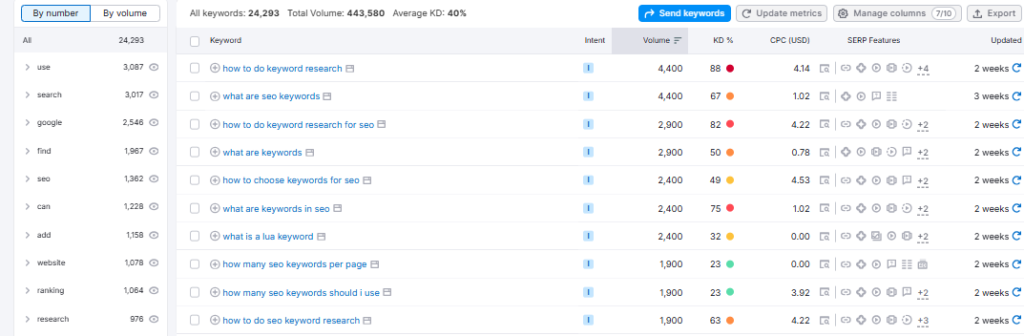
Keyword research tools show the user intent and primary and secondary keywords.
Search Volume of the keyword
Before picking any keyword as a primary keyword, one should be aware of the volume of the keyword. This means how many people have been searching for this keyword in a particular time, usually one month.
There are a wide number of tools, like Google Keyword Planner, that give the flexibility of free and paid services. This tool shows the average volume of searches in different countries and the difficulty level of a particular keyword.
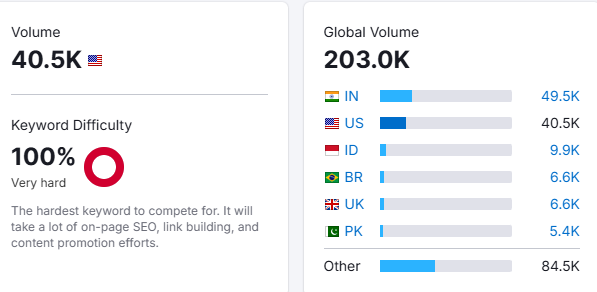
Along with this, it shows the number of people who search this keyword and the intent of the user.